

Filter bag manufacturers often face a core question when upgrading production lines: should they invest in a long‑arm filter bag sewing machine, or a cylinder‑bed walking‑foot model? Both machines are built for heavy‑duty filter felt sewing, but they are designed for completely different sewing positions and filter bag structures.
Choosing the wrong machine will limit your product range, cause awkward fabric handling, increase rejected bags, and slow down your production efficiency. Below we break down their working principles, suitable products, key advantages, and practical selection advice for filter bag factories.
1. What is a Long‑arm Filter Bag Sewing Machine?
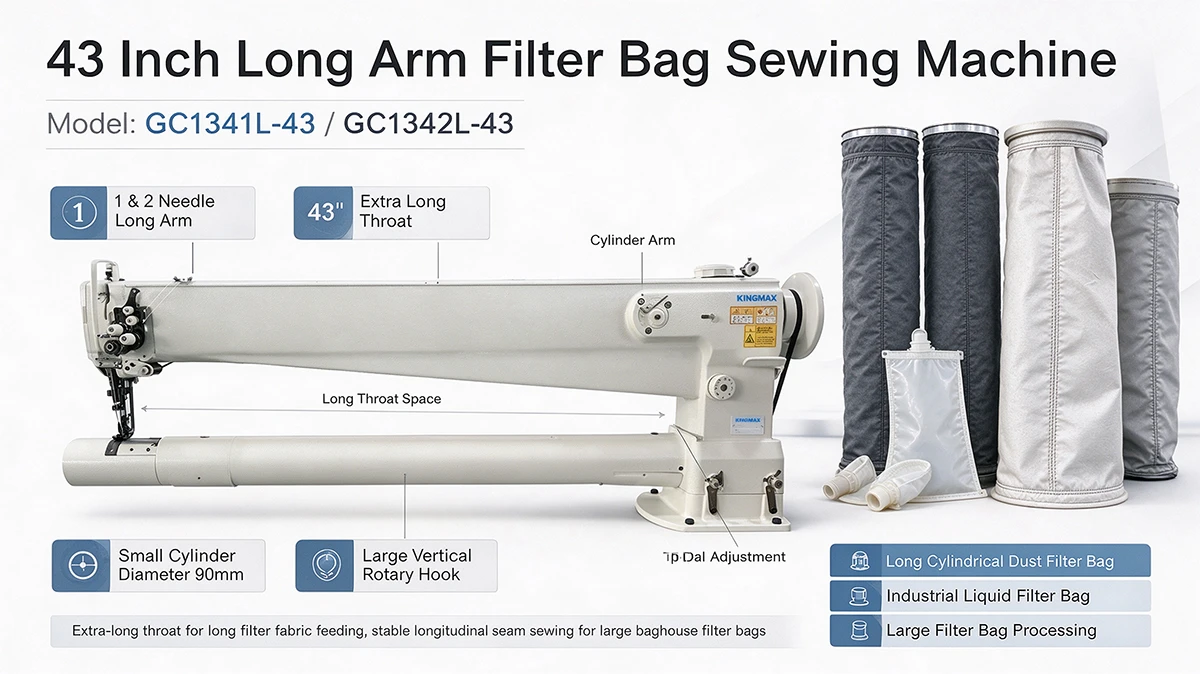
Long‑arm Filter Bag Sewing Machine
Long‑arm machines feature an extended throat distance (the space from needle to machine column). Our lineup covers 18‑inch and 43‑inch long‑arm models. The extended throat space is the biggest advantage. Operators can feed the whole cylindrical filter bag into the working area, and sew the long longitudinal seam of the filter bag body.
- 18‑inch long‑arm filter bag sewing machine It is a cost‑effective mainstream model. Suitable for medium‑length dust filter bags, liquid filter bags and small‑diameter baghouse filter bags. Ideal for small & medium filter bag factories that produce mixed orders. It handles 450–700 g/m² needle punched felt well.
- 43‑inch extra long‑arm filter bag sewing machine The ultra‑long working throat targets extra‑long cylindrical dust filter bags, which are widely used in large power plant, cement plant and waste incineration baghouses. The 43‑inch deep space lets operators fully spread the long filter felt tube during side seam sewing, avoiding fabric twisting, folding and uneven stitch density.
Core strengths of long‑arm machines:
- Large flat working area for long straight seam sewing on filter bag tube body
- Flexible for both dust filter bags and industrial liquid filter bags
- 18" model saves workshop budget; 43" model is specialized for long bag production
- Walking foot compound feed option prevents thick multi‑layer felt from shifting during sewing
Limitation: Long‑arm machines are not convenient for 360° circular sewing around the bag mouth or bag bottom. When sewing the circular cuff or bottom reinforcement, you need to keep rotating the whole filter bag, which is inefficient for mass production of round bag ends.
2. What is a Cylinder‑bed Walking‑Foot Filter Bag Sewing Machine?
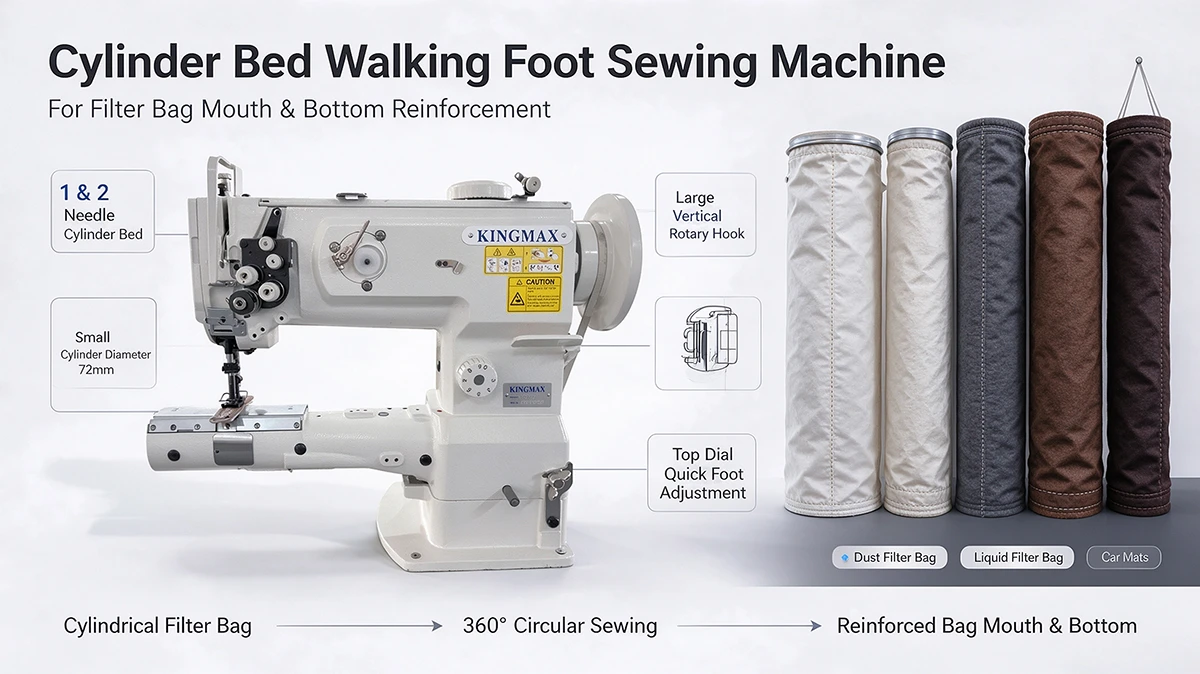
Cylinder Bed Walking Foot Filter Bag Sewing Machine
Cylinder‑bed (tube arm) machines have a narrow cylindrical bed instead of a flat long worktable. The filter bag sleeve can be directly slipped onto the cylinder arm, and rotated freely around the arm.
This design makes it perfect for 360° circular sewing: bag mouth cuff stitching, bag bottom circular reinforcement, and ring tape attachment.
The built‑in walking foot compound feed system is critical here. Filter felt is thick, fibrous and slippery. Ordinary single‑presser foot machines easily create layer slipping, staggered fabric and inconsistent stitch tension. Walking foot synchronously moves the top presser foot, needle and bottom feed dog together. All fabric layers advance at the same speed, even for multi‑layer overlapping reinforcement sections.
Core strengths of cylinder‑bed machines:
- Cylinder tube arm allows easy rotation of cylindrical filter bags
- High efficiency for circular sewing of bag mouth and bag bottom reinforcement
- Heavy‑duty walking foot compound feed, stable sewing for thick PPS, PTFE, aramid laminated felt
- Consistent seam tensile strength, reduces leakage risk at bag cuff and bottom
Limitation: The cylinder arm cannot accommodate full‑length long filter bag body. It is not designed for sewing the long longitudinal side seam of filter bags.
3. How to Make Your Final Selection?
Scenario 1: You mainly sew the long side seam / tube body of filter bags
👉 Choose Long‑arm Filter Bag Sewing Machine
Short & medium filter bags, mixed orders → 18‑inch long‑arm
Extra‑long dust collector bags for power / cement plants → 43‑inch long‑arm
Scenario 2: You focus on bag mouth cuff and bag bottom circular reinforcement sewing
👉 Choose Cylinder‑bed Walking‑Foot Filter Bag Sewing Machine
Scenario 3: Full filter bag production (side seam + bag mouth + bag bottom)
👉 Best solution: Combine both types Use long‑arm machine to sew the longitudinal body seam and form the filter bag tube; then transfer to cylinder‑bed machine to finish circular cuff and bottom reinforcement. This matching configuration is the standard mature workflow for most professional filter bag factories.
Understand the Value of Walking‑Foot Compound Feed
Walking foot is not an optional luxury for filter bag sewing - it is a must‑have feature.
Filter materials like polyester felt, PPS, PTFE membrane laminated felt are thick and slippery. When you stack 2–4 layers for reinforcement, normal sewing machines pull top and bottom fabric at different speeds. The result: layer shifting, wavy seams, skipped stitches and unstable seam strength.
Walking foot delivers synchronized feeding. Every fabric layer moves together. Stitch density stays uniform along the whole seam. High and stable seam tensile strength avoids pinhole leakage under high flue gas pressure. This directly reduces your finished filter bag rejection rate.
Matching Our Complete Filter Bag Production Line
Besides sewing machines, we also supply filter bag strip cutting machines. It cuts raw filter fabric into required tapes for bag cuff reinforcement strips before sewing.
Full workflow: Filter fabric slitting (strip cutting machine) → Longitudinal seam sewing (18" /43" long‑arm machine) → Circular bag mouth & bottom sewing (cylinder‑bed walking foot machine) → Inspection & finished filter bags.
Long‑arm = Long straight seam of filter bag body, choose throat depth based on your maximum bag length
Cylinder‑bed = Circular sewing for bag mouth & bag bottom, prioritize walking foot model
For full‑scale filter bag manufacturing, the two machines work as a matched set, not competitors.
If you send us your filter bag size, fabric gram weight and daily output target, our engineering team can recommend the most suitable machine combination for your factory.