

The lifting loops of the big bag are made of multiple layers of high-density polypropylene webbing, which are thick and stiff. During sewing, the upper and lower layers are prone to slippage and misalignment due to poor material feeding. At the same time, the large size of the bag limits the sewing space for the bottom and waist lifting rings, making operation difficult. In addition, the lifting rings need to bear several tons of weight, and the stitching must be both high-strength and elastic to withstand impact, and must be precisely positioned. Any deviation could pose a safety hazard.
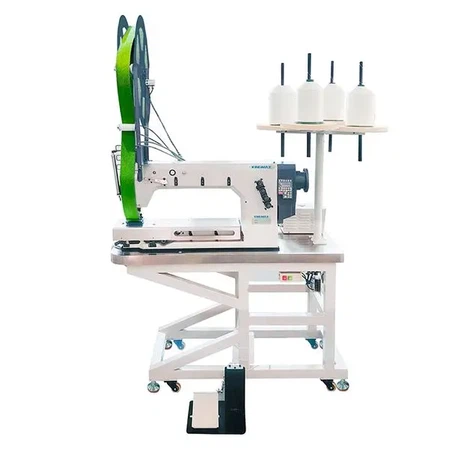
Based on the above issues, the GK82810-D big bag lift loops sewing machine provided by KINGMAX can solve them.
- Sewing Structure Specifically Designed for Ultra-Thick Material Layers and High-Strength Loads

The lifting loops of the big bag are typically made of 4-6 layers or even thicker polypropylene webbing, and need to withstand tensile forces of several tons.
Combined Upper and Lower Feeding System: The machine is equipped with a combined upper and lower feeding structure. This is crucial when sewing thick materials, ensuring that the upper webbing, the middle bag body, and the lower reinforcing mesh are fed synchronously. This effectively avoids the "wrinkling," "layer shifting," or "edge slippage" phenomena commonly found in ordinary sewing machines when sewing thick materials, guaranteeing absolute precision in strap positioning.
Double-Needle Four-Thread Chain Stitch: Utilizes 401 stitch (double chain stitch). Compared to lockstitch, this stitch offers better tensile elasticity and higher sewing strength. When the strap is under stress, the chain stitch provides some deformation cushioning, resisting impact and reducing the risk of thread breakage, meeting the requirements of big bag straps to withstand enormous tensile forces.
- Structural Optimization for Large Sizes and Special Working Spaces
 The large size of big bag, especially when sewing the bottom, waist, and mouth straps, often makes working space a key factor limiting efficiency.
Large Operating Space (Long Arm Design): This model offers a 530mm underarm length and a 190mm underarm width. This is a typical "long arm" or "extra-long arm" specification. Such ample space allows operators to easily tuck the entire corner or bottom of the FIBC under the machine head for rotary sewing without being obstructed by the machine arm, making it particularly suitable for situations requiring a wide range of movement for sewing, such as "cross-bottom" or "mesh bottom" designs.
Diverse Stitch Length Adaptability: Offers 7mm, 30mm, and 45mm stitch lengths. Appropriate stitch lengths can be selected for different strap widths; especially wide stitch lengths (such as 30 or 45mm) can directly cover the strap edge for one-step sewing, eliminating the need for double stitches and significantly improving sewing efficiency.
- Automated Assistance and Powerful Power Support

During loop sewing, auxiliary actions such as positioning and thread cutting are very physically demanding. This machine's configuration specifically addresses these pain points.
Pneumatic Presser Foot Lift: Due to the thickness and weight of the materials being sewn, manually lifting the presser foot is very strenuous and inefficient. The pneumatic presser foot not only frees the operator's knees or hands but also provides stable and powerful clamping force, facilitating quick and easy adjustment of the sling position.
Hot Thread Cutting and Guiding Device:
Webbing Guiding Device: This device is specifically designed for webbing sewing, ensuring the sling remains straight before entering the presser foot, preventing crooked sewing.
Hot Thread Cutting: When sewing polypropylene (PP) or polyester webbing, ordinary mechanical scissors are prone to wear and cannot cut thick fibers. Utilizing a hot-wire to melt the webbing and thread braids at high temperatures not only cuts instantly but also fuses the cut to prevent fraying, improving the quality of the sling end processing.
Direct-drive high-power motor: The direct-drive structure reduces power loss, and the high-power motor ensures that the machine will not experience "jamming" or needle breakage due to insufficient power when piercing ultra-thick layers (loops + bag body + reinforcing fabric).