

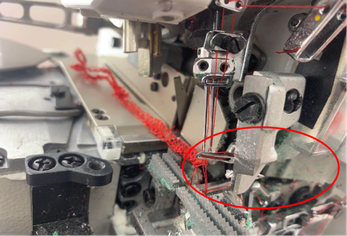
In the daily use of industrial sewing machines, skipped stitches are one of the most troublesome problems for operators-interrupted thread movement and crooked stitches not only affect production efficiency but can also damage the fabric. Many people immediately think of adjusting the top thread tension or checking the bottom thread, but a culprit that is easily overlooked is actually: the ''needle''.
Although small, the needle directly determines the stability of the thread loop formation. Improper installation, incorrect model, or slight deformation can cause the sewing machine to fail to hook the thread properly, resulting in skipped stitches. Below, we've compiled a systematic checklist from the perspective of the needle.
I. Threading and Installation: Basic Steps Most Prone to Errors
First, check if the thread is threaded incorrectly or if a stitching point has been missed. Incorrect threading paths directly disrupt thread tension, preventing the thread loop from forming properly. Simultaneously, confirm the needle is installed in the correct direction-the long groove should face the operator (or the direction specified for specific models), and the needle body should be fully inserted to the top of the needle bar. If the needle is installed at an angle or not fully inserted, the needle tip position deviation will prevent the rotary hook from accurately hooking the loop.
II. Needle Bar Height: Perfectly Balanced
Improper needle bar height adjustment is a common cause of skipped stitches. If the needle is installed too high, the insertion depth is insufficient, and the loop cannot reach the rotary hook's hooking position; if it is installed too low, the needle hole is too far from the rotary hook, also causing hooking failure. The correct height should be referred to the model manual, ensuring that when the needle is lowered to its lowest point, the upper edge of the needle hole maintains a gap of approximately 0.1mm with the tip of the rotary hook.
III. Bent Needle: An Invisible "Hidden Killer"
Using a bent needle is a major cause of skipped stitches. Even a slight bend will cause the needle tip to deviate from the intended path, resulting in the loop being far from the rotary hook and the hook failing to hook the thread. The human eye cannot easily distinguish minute bends. An effective testing method is to place the needle flat on a glass or metal platform and gently roll it, observing whether the needle body warps or curves. If even a slight bend is observed, the needle should be replaced immediately.
IV. Timing of Needle and Hook Matching: Precise to Milliseconds
Industrial sewing machines rely on the precise matching of the hook tip and the needle to pick up the thread loop. If the timing of their movements is mismatched-for example, the hook tip arrives at the needle eye too early or too late-the loop will be missed. During inspection, the timing of the hook tip meeting the needle can be observed by slowly turning the handwheel: when the needle rises approximately 2.2~2.5mm from its lowest point, the hook tip should be exactly 0.1~0.2mm above the needle eye. If the timing is off, the phase relationship between the hook and the needle bar needs to be adjusted.
V. Matching Needle and Thread: The thickness must be "perfectly matched"
The needle's size (number) must be compatible with the thickness of the sewing thread. Using an oversized needle (e.g., an 18-gauge needle with 80-gauge thread) results in a long and wide needle eye. This creates an excessively large hole after piercing the fabric, allowing the thread considerable room to move and potentially causing it to deviate from the hook's catch, leading to skipped stitches. Conversely, using an undersized needle with thick thread can cause poor thread flow. The standard practice is that the thread should easily pass through the needle eye, with the thread diameter approximately 60% to 70% of the needle eye's width.
VI. Needle Eye Clogging: Problems Caused by Accumulated Synthetic Fiber Scrap
When sewing synthetic fabrics, the heat generated by high-speed friction melts and adheres to the inner wall of the needle eye, eventually clogging it. This hinders the smooth flow of thread, preventing proper loop formation and even causing thread breakage. Regular maintenance involves checking the needle eye for cleanliness. If black, burnt-looking material is present, clean it with a fine wire or a special needle. Replace the needle if necessary.
Summary and Tips: When an industrial sewing machine experiences skipped stitches, there's no need to rush into a major overhaul. Following the steps outlined above-first check the threading installation, then adjust the needle bar height, followed by checking the needle straightness, adjusting the hook timing, matching the thread diameter, and clearing any blockages in the needle hole-often resolves the problem quickly. Although the needle is a small component, it deserves meticulous attention, almost like a microscope.
To contact us:
Whatsapp:86-13991289750
Wechat:86-18192599756
Email:dekoco@vip.163.com ,sales@kingmaxsew.com
Website:www.kingmaxsew.com