


As the core filtration component of baghouse dust collectors, filter bags directly determine dust removal efficiency, equipment operating costs, and environmental emission compliance rates. During production, filter bag failure not only leads to excessive dust emissions and fan wear, but also results in significant economic losses due to downtime for maintenance and frequent bag replacements. Accurately identifying the causes of failure, scientifically investigating and addressing them, and simultaneously improving the structural strength of filter bags from the manufacturing stage have become key issues in industrial dust collection operation and maintenance.
Filter bag failure can be mainly categorized into three types: failure due to breakage, failure due to increased resistance, and failure due to excessive emissions. Among these, failure due to breakage is the most common and has the most direct impact. Based on the on-site operating conditions and the form of damage, the main causes can be divided into two categories: aerodynamic damage and mechanical damage.
I. Aerodynamic Damage: Regular Damage Caused by Airflow Erosion
Airflow erosion is the main cause of damage to the filter bag opening, body, and bottom. The location of the damage follows a clear pattern, facilitating rapid identification.
Pulse-jet Airflow Damage: Damage is mostly concentrated 10-15cm below the bag opening, presenting as a stepped tear from the inside out. This is often caused by excessive pulse-jet pressure, misalignment of the pulse-jet tube (not perpendicular to the bag opening), or missing venturi tubes.
External Dust Erosion: Localized wear on the bag body and tearing at the bottom are often caused by uneven airflow distribution, excessively high ash levels in the ash hopper creating bottom swirl, or direct airflow from leaks at the primary dust collector connection.
Key Inspection Points: Check the verticality and fixation of the pulse-jet tubes, the airflow distribution device, and the ash hopper level; optimize cleaning parameters, install venturi tubes and protective sleeves for the filter bag frame, and seal the duct interfaces.
II. Mechanical Damage: Structural damage caused by friction and abrasion.
Mechanical damage often stems from installation and accessory defects. The location of the damage is highly correlated with the friction between the filter bag and the filter frame.
Filter Frame Abrasion and Cutting: Rust, burrs, and weld protrusions in the filter frame can cause linear damage at the corresponding locations between the filter bag and the frame ribs.
Bag Friction Damage: Improperly installed filter bags, insufficient spacing, and swaying collisions during operation lead to bag wear.
Installation Abrasion Damage: Filter bags are scratched by tube sheets or sharp corners of components during unpacking and installation.
Key Points for Troubleshooting: Replace with burr-free, rust-proof filter frames; ensure proper installation to guarantee filter bag verticality; avoid bag compression; handle with care during installation to prevent abrasion.
III. Addressing the Problem at its Source: High-Quality Sewing + Professional Equipment Extends Filter Bag Lifespan
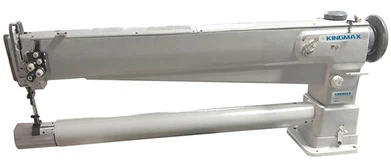
Besides maintenance factors, defects in sewing processes, insufficient thread strength, and weak edge sealing at the bag opening are also significant causes of early filter bag failure. Poor sewing quality leads to rapid seam opening and tearing of the filter bag under airflow and repeated dust cleaning, drastically shortening its lifespan.
Using professional filter bag sewing machines addresses structural weaknesses at the production source: the equipment supports double/multi-needle precision sewing, long-stroke operation with a long-arm, and composite feeding for multi-layer filter media. It reinforces key areas such as the bag opening, body, and bottom, ensuring even and strong stitches without skipped stitches or loose threads. It is compatible with various filter media including polyester, PPS, PTFE, and fiberglass, significantly improving the filter bag's resistance to erosion and friction, fundamentally reducing early damage and lowering maintenance and replacement costs.
Accurate damage identification combined with high-standard sewing processes ensures long-term stable operation of filter bags, safeguarding the efficient operation of dust collection systems.
Choosing professional filter bag sewing machines can address structural weaknesses at the source of production. KINGMAX provides these high-quality sewing machines, precisely resolving various potential problems in the filter bag sewing process and preventing early damage to the filter bags. KINGMAX filter bag sewing machines support double/multi-needle precision sewing, long-stroke operation with a long thread arm, and composite feeding for multi-layer filter media. Leveraging its composite feeding and precision sewing technology, it reinforces key areas prone to damage, such as the bag opening, body, and bottom, ensuring even and strong stitches without skipped stitches or loose threads. It perfectly adapts to various filter media, including polyester, PPS, PTFE, and fiberglass, significantly improving the filter bags' resistance to erosion and friction, fundamentally reducing early damage and lowering maintenance and replacement costs.
Accurate damage detection, combined with the high-standard sewing process provided by KINGMAX professional sewing machines, ensures long-term stable operation of the filter bags, safeguarding the efficient operation of the dust collection system.
To contact us:
Whatsapp:86-13991289750
Wechat:86-18192599756
Email:dekoco@vip.163.com ,sales@kingmaxsew.com
Website:www.kingmaxsew.com