

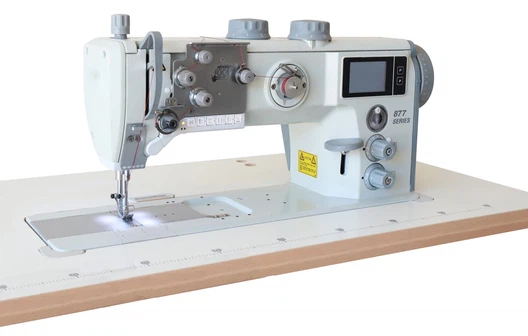
On production lines in industries such as textiles, apparel, home furnishings, and leather goods, flatbed sewing machines, as the most basic and widely used sewing equipment, are demonstrating new vitality through continuous technological innovation. Their core working principle involves using a single sewing thread to create a simple lockstitch on the fabric, achieving a strong bond between one or more layers of material. Although this stitch has a simple structure, it is neat, beautiful, and even, making it an indispensable key piece of equipment in modern sewing production.
- Professional Classification Meets Diverse Production Needs
From a professional application perspective, flatbed sewing machines have developed a clear classification system, mainly divided into two types based on the thickness of the processed material: thin materials and thick materials. Thin material flatbed sewing machines are specifically designed for lightweight materials such as knitted fabrics, underwear, shirts, and uniforms. Through a precise feeding system and needle bar mechanism, they ensure that thin materials are sewn without wrinkles or arching. Heavy-duty flatbed sewing machines are designed for heavy materials such as sportswear, denim, fashion apparel, coats, shoes, hats, leather goods, and bags. Equipped with a more powerful drive system, a special feed dog structure, and reinforced needles, they can easily penetrate multiple layers of thick materials, ensuring strong stitches.
This specialized classification allows flatbed sewing machines to adapt to the processing needs of various fabrics, including cotton, linen, silk, wool, and synthetic fibers, as well as special materials such as leather, plastics, and paper, reflecting the highly specialized characteristics of modern manufacturing equipment.
- Technical Specifications Highlight Superior Performance
In terms of performance, modern flatbed sewing machines exhibit impressive technical specifications. Maximum sewing speeds reach 4000-5000 rpm, meaning thousands of stitches can be completed per minute, significantly improving production efficiency. This high-speed operation is thanks to a precise mechanical structure and optimized power system, enabling flatbed sewing machines to meet the demands of large-scale industrial production while maintaining sewing quality.
Ease of operation is also a key feature of flatbed sewing machines. Intuitive control mechanisms and easy-to-understand operation lower the barrier to entry, enabling operators to quickly master equipment use and reducing training costs and time.
- Technological Innovation Drives Industrial Upgrading
Currently, flatbed sewing machine technology is rapidly evolving towards intelligence and precision. More and more flatbed sewing machines are equipped with microcomputer control systems, capable of precisely controlling parameters such as sewing speed, stitch length, and sewing tension. Some high-end models have also incorporated intelligent functions such as automatic thread trimming, automatic reverse sewing, and needle positioning, further improving operational convenience and production efficiency.
In terms of mechanical structure, the application of new materials and processes makes the core components of flatbed sewing machines more durable and reliable. Optimized rotary hook structures, precise feeding systems, and improved presser foot devices collectively ensure the stability and consistency of sewing quality.
- Broad Application Prospects, Supporting Industrial Upgrading
As the textile and apparel industry develops towards high-quality development, technological innovation in flatbed sewing machines is injecting new momentum into the entire industry. From high-end custom fashion to large-scale industrial production, from traditional textiles to new composite materials, the application areas of flatbed sewing machines are constantly expanding.
Industry experts point out that future flatbed sewing machines will place greater emphasis on energy conservation and environmental protection, reducing energy consumption and noise levels, while further improving operational comfort and intelligence. Integration with industrial internet technology will also bring new development opportunities to flatbed sewing machines, enabling real-time data collection and analysis to provide decision support for production management.
As the most basic type of sewing equipment, the flatbed sewing machine's technological innovation and professional development fully reflect the manufacturing industry's transformation from extensive to intensive production, and from traditional to intelligent methods. With continuous technological advancements, this classic piece of equipment will continue to play an irreplaceable and vital role in the textile and apparel industry and related sectors, providing solid support for industrial upgrading and high-quality development.
If your want to learn more about or plan to purchase high quality flat bed sewing machine, please feel free to contact KINGMAX.
To contact us:
Whatsapp:86-13991289750 Wechat:86-18092437695
Email:dekoco@vip.163.com ,sales@kingmaxsew.com
Website:www.kingmaxsew.com